In the vast, arid expanses of deserts, where water is as scarce as life itself, a revolutionary technology is emerging to quench the thirst of both humans and ecosystems. The aerogel water-harvesting mesh, a marvel of material science, is turning the seemingly impossible into reality—extracting drinkable water from the dry desert air, day and night. This innovation isn’t just a scientific curiosity; it’s a beacon of hope for water-scarce regions around the globe.
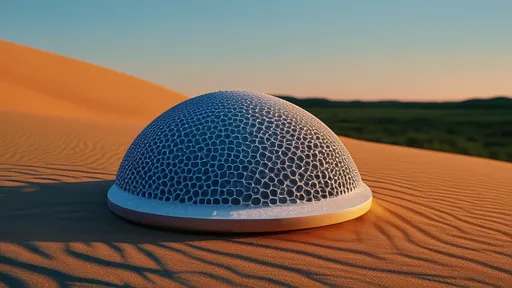
The concept of harvesting water from air isn’t new. For centuries, people in arid regions have used rudimentary methods like dew traps or fog nets. However, these techniques are often inefficient, relying on specific climatic conditions such as high humidity or coastal fog. The aerogel mesh, on the other hand, operates independently of these limitations. Its secret lies in the unique properties of the material—a super-light, porous structure that mimics the natural water-capturing abilities of desert beetles and cacti.
How does this futuristic mesh work? During the cooler night hours, the aerogel’s hydrophilic (water-attracting) surface condenses moisture from the air, forming tiny water droplets. As temperatures rise during the day, the material’s hydrophobic (water-repelling) layer pushes the collected water toward storage channels without evaporation losses. This continuous cycle—capturing at night, releasing by day—creates a self-sustaining water supply even in environments with as little as 20% relative humidity.
What sets this technology apart is its staggering efficiency. Field tests in the Sahara demonstrated that one square meter of aerogel mesh can produce up to 2.5 liters of water per day—enough to sustain a small plant or contribute significantly to a person’s daily water needs. When scaled into arrays, these systems could support entire communities or agricultural projects. Unlike energy-intensive desalination or groundwater pumping, this process requires no electricity, making it ideal for off-grid applications.
The environmental implications are profound. Traditional water sourcing in deserts often involves deep wells that deplete ancient aquifers or trucked-in supplies with heavy carbon footprints. Aerogel harvesting presents a sustainable alternative that works in harmony with natural atmospheric cycles. Researchers note that widespread adoption could reduce pressure on dwindling groundwater reserves while providing a climate-resilient solution as aridification expands due to global warming.
Beyond human consumption, this technology opens new possibilities for desert agriculture and ecosystem restoration. Experimental greenhouses in Qatar are already using aerogel-collected water to irrigate crops without external water inputs. Conservationists speculate about using such systems to create "water oases" that could help endangered desert species survive prolonged droughts.
Of course, challenges remain before mass deployment becomes feasible. Current aerogel production costs are high, though researchers at MIT and ETH Zurich are developing cheaper, bio-based alternatives. Durability under constant UV exposure and sand abrasion requires further material enhancements. Nevertheless, with pilot programs showing promising results from Chile to the UAE, the aerogel water revolution may soon emerge from labs into the blistering heat of real-world deserts.
As climate change intensifies water scarcity for nearly two billion people worldwide, solutions like the aerogel mesh transition from innovative to essential. This technology embodies a paradigm shift—from extracting water from the ground to harvesting it from the endless aerial rivers flowing invisibly above even the driest landscapes. The desert, long a symbol of barrenness, may yet become a testament to human ingenuity’s ability to find abundance in apparent scarcity.

By /Jul 28, 2025

By /Aug 5, 2025

By /Jul 28, 2025
By /Jul 28, 2025

By /Aug 5, 2025
By /Jul 28, 2025

By /Aug 5, 2025

By /Aug 5, 2025

By /Jul 28, 2025
By /Jul 28, 2025

By /Aug 5, 2025

By /Aug 5, 2025

By /Jul 28, 2025

By /Aug 5, 2025

By /Aug 5, 2025
By /Jul 28, 2025

By /Aug 5, 2025

By /Aug 5, 2025
By /Jul 28, 2025

By /Jul 28, 2025
