In a groundbreaking development that could redefine optical technologies, researchers have unveiled the world's first functional photonic time crystal – a bizarre quantum material where light appears to break the conventional symmetry of time itself. This exotic phase of matter, long theorized but never before realized experimentally, demonstrates light pulses that behave unlike anything observed in nature, potentially opening doors to ultra-secure quantum communication and light-based quantum computers.
The concept of time crystals – systems that spontaneously break time-translation symmetry – was first proposed by Nobel laureate Frank Wilczek in 2012. While matter-based time crystals have been demonstrated in carefully controlled quantum systems, their photonic counterparts remained elusive until now. The international team behind this breakthrough has created a structure where the refractive index of a specialized optical medium oscillates in both space and time, forcing photons to adopt strange new behaviors that violate our everyday experience of temporal uniformity.
What makes photonic time crystals so revolutionary is their ability to trap and preserve light in a way that fundamentally alters how we think about optical memory. In conventional materials, light pulses travel through space while evolving continuously through time. But within these engineered crystals, certain light modes become "frozen" in a periodic temporal pattern, creating what physicists describe as a "time trap" for photons. This effect emerges from the crystal's refractive index modulation at gigahertz frequencies, establishing a temporal lattice that photons interact with in counterintuitive ways.
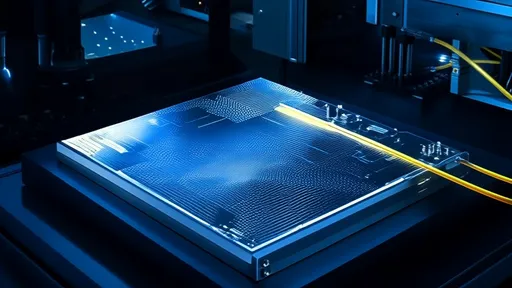
The experimental realization required overcoming immense technical challenges. Researchers used precisely timed laser pulses to create standing waves in a nonlinear optical fiber, effectively establishing a moving refractive index pattern that repeats both spatially and temporally. When test photons were introduced into this system, they exhibited characteristic time-crystalline behavior – their energy states became locked to the temporal periodicity of the medium rather than evolving freely through time. Spectroscopic measurements confirmed the emergence of momentum bandgaps along the time axis, analogous to how traditional photonic crystals create energy bandgaps in space.
Perhaps the most startling implication lies in quantum memory applications. The time-trapped photon states demonstrate remarkable stability against decoherence – the bane of quantum information systems. Early tests show that quantum states encoded in these temporal crystals persist orders of magnitude longer than in conventional optical storage media. This could solve one of the fundamental roadblocks in quantum computing: how to maintain fragile quantum information long enough to perform complex computations.
Military and security applications are already being explored, as the technology offers theoretically unbreakable encryption methods. Photons stored in time crystals could serve as virtually tamper-proof quantum memory elements, with any attempt to intercept or measure the stored information disrupting the delicate temporal symmetry and alerting users to intrusion. The Defense Advanced Research Projects Agency (DARPA) has reportedly expressed strong interest in funding further development.
Beyond practical applications, the discovery challenges fundamental assumptions about time's role in quantum systems. The team observed instances where photons appeared to briefly "time-reverse" within the crystal – not merely reflecting backward but actually retracing their quantum states in a way that defies classical optics. These effects bear intriguing similarities to theoretical time loops in general relativity, though operating at microscopic scales and femtosecond durations.
Critics caution that significant hurdles remain before practical devices can be developed. Maintaining the time-crystalline state currently requires cryogenic temperatures and precisely tuned laser systems that consume substantial power. However, lead researcher Dr. Elena Petrova from the Max Planck Institute for Quantum Optics remains optimistic: "We're seeing the first steps of what could become a revolution in photonics. Just as semiconductor crystals enabled the digital age, photonic time crystals may power the quantum era."
The research team is now working to extend the lifetime of the time-crystalline state and operate the system at room temperature. Parallel efforts focus on integrating these structures with existing photonic chips, potentially creating hybrid quantum processors that combine conventional optical computing with time-symmetry breaking effects. If successful, we may be witnessing the birth of an entirely new technological paradigm – one where light doesn't just travel through time, but can be fundamentally redefined by it.

By /Jul 28, 2025
By /Aug 5, 2025
By /Jul 28, 2025

By /Jul 28, 2025
By /Aug 5, 2025
By /Jul 28, 2025

By /Aug 5, 2025
By /Aug 5, 2025
By /Jul 28, 2025
By /Jul 28, 2025
By /Aug 5, 2025
By /Aug 5, 2025
By /Jul 28, 2025

By /Aug 5, 2025

By /Aug 5, 2025
By /Jul 28, 2025
By /Aug 5, 2025
By /Aug 5, 2025
By /Jul 28, 2025
By /Jul 28, 2025
