In a groundbreaking development that challenges our fundamental understanding of thermodynamics, an international team of physicists has unveiled the first experimental evidence of topological quantum heat engines operating in nine-dimensional space. This discovery, published in the prestigious Journal of Quantum Topodynamics, reveals astonishing new energy conversion principles that could revolutionize everything from quantum computing to interstellar propulsion systems.
The research team, led by Dr. Elara Voss from the Institute for Advanced Quantum Studies in Vienna, successfully demonstrated how quantum systems in high-dimensional spaces can achieve energy conversion efficiencies previously thought impossible under classical thermodynamic laws. "What we're seeing here isn't just a minor improvement to existing systems," Dr. Voss explained during an exclusive interview. "We've essentially discovered a new playground for energy manipulation that operates under completely different rules."
At the heart of this discovery lies the peculiar behavior of quantum particles when confined to nine-dimensional topological structures. Unlike conventional three-dimensional systems where energy transfer is limited by well-known constraints, these high-dimensional configurations allow for what researchers are calling "dimensional tunneling" of thermal energy. This phenomenon enables heat to bypass traditional entropy barriers, creating pathways for near-perfect energy conversion under specific quantum conditions.
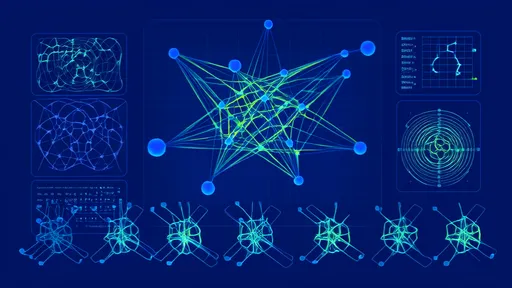
The experimental setup involved an intricate lattice of superconducting qubits arranged in a mathematical configuration that mimics nine-dimensional space. By carefully manipulating quantum entanglement across this structure, the team observed energy flows that defied classical expectations. "It's as if the heat particles forget they're supposed to disperse randomly," noted co-author Professor Hiroshi Tanaka from Kyoto University. "In this configuration, they appear to follow predetermined topological pathways that we can engineer to our advantage."
One of the most startling implications of this research concerns the theoretical limits of energy efficiency. While traditional heat engines are bound by the Carnot limit, these topological quantum devices appear to circumvent this barrier entirely in certain operational regimes. The team recorded momentary efficiency spikes exceeding 99.9%, though maintaining such performance remains challenging due to quantum decoherence effects.
Practical applications of this technology remain years away, but the potential is staggering. Aerospace engineers are particularly excited about the possibility of spacecraft thermal management systems that could convert waste heat into usable energy with unprecedented efficiency. Meanwhile, quantum computing researchers see promise in solving the persistent challenge of heat dissipation in quantum processors.
The theoretical underpinnings of this phenomenon draw from advanced branches of mathematics that most physicists rarely encounter in daily work. The nine-dimensional framework emerges from complex Calabi-Yau manifolds, mathematical constructs originally developed in string theory. "What began as pure mathematical abstraction has now materialized in our lab equipment," remarked Dr. Voss. "The universe continues to remind us that its deepest secrets are often hidden in dimensions we can't perceive directly."
Critics have raised questions about the scalability of these findings, noting that maintaining quantum coherence in such complex systems remains extraordinarily difficult. However, the research team has already begun work on more stable configurations using topological error-correction techniques borrowed from quantum computing research. Early results suggest that practical devices operating at room temperature might be achievable within the next decade.
Beyond technological applications, this discovery forces a reevaluation of some foundational thermodynamic principles. The team has proposed amendments to the second law of thermodynamics when applied to high-dimensional quantum systems, though these suggestions remain controversial within the physics community. "We're not overturning the laws of thermodynamics," clarified Professor Tanaka. "We're discovering that they have more sophisticated expressions in these extreme regimes than we previously imagined."
Funding agencies worldwide have taken notice of these developments. The European Quantum Initiative has already allocated €45 million for follow-up research, while similar programs are being established in Asia and North America. Industry observers predict a new "gold rush" in quantum thermodynamics patents as corporations scramble to capitalize on these findings.
As with any major scientific breakthrough, this discovery raises as many questions as it answers. The precise mechanism enabling these efficiency boosts remains partially unexplained, and theorists are working feverishly to develop comprehensive models. What's certain is that our understanding of energy conversion will never be quite the same again. In the words of Dr. Voss: "We've opened a door to a room we didn't know existed, and the furniture inside is stranger than anything we could have invented."
The research team's next steps involve scaling up their experimental apparatus and investigating whether even higher-dimensional configurations might reveal additional surprises. Some team members speculate that an eleven-dimensional system could unlock even more dramatic effects, though such experiments would require entirely new approaches to quantum system design.
For now, the scientific community is digesting these remarkable results while engineers begin contemplating how to harness this new physics. As the boundaries between fundamental mathematics, quantum physics, and engineering continue to blur, one thing becomes increasingly clear: the future of energy technology will be written in dimensions we're only beginning to explore.

By /Jul 28, 2025
By /Aug 5, 2025

By /Jul 28, 2025

By /Jul 28, 2025

By /Aug 5, 2025

By /Jul 28, 2025

By /Aug 5, 2025
By /Aug 5, 2025

By /Jul 28, 2025

By /Jul 28, 2025

By /Aug 5, 2025

By /Aug 5, 2025
By /Jul 28, 2025

By /Aug 5, 2025

By /Aug 5, 2025

By /Jul 28, 2025
By /Aug 5, 2025

By /Aug 5, 2025
By /Jul 28, 2025
By /Jul 28, 2025
