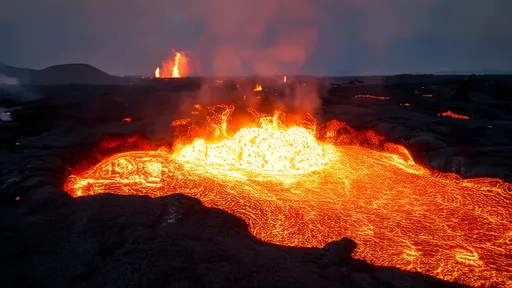
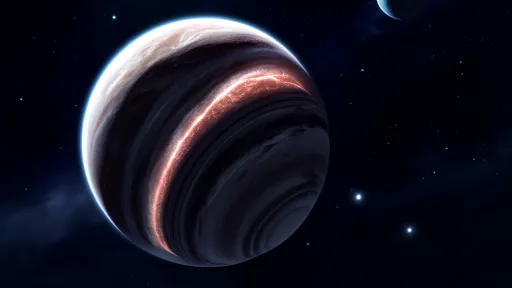
The discovery of exoplanets has revolutionized our understanding of planetary systems, revealing worlds far beyond the scope of our solar system. Among these distant orbs, some exhibit extreme conditions, such as molten lava oceans under the unrelenting gaze of their host stars. These so-called "lava worlds" present a fascinating glimpse into the dynamics of planetary surfaces locked in gravitational embrace with their suns, where tidal forces sculpt the very fabric of their geology.
Tidal locking ensures that one side of these exoplanets perpetually faces their star, bathing in scorching heat, while the other remains shrouded in eternal darkness. This stark contrast creates a temperature gradient so severe that it drives the circulation of molten rock across the planet's surface. Recent studies suggest that this process may not be a chaotic, turbulent mess but rather a structured, cyclical flow—akin to ocean currents on Earth, but forged in liquid stone.
Scientists have turned to advanced computational models to simulate these exotic environments. The results indicate that the magma oceans on tidally locked exoplanets could form vast, slow-moving convection cells. On the dayside, where temperatures soar beyond 2,000 degrees Celsius, the molten rock expands and rises, only to cool and sink as it flows toward the frigid nightside. This creates a continuous loop, redistributing heat across the planet in a manner that might even influence atmospheric retention and volcanic activity.
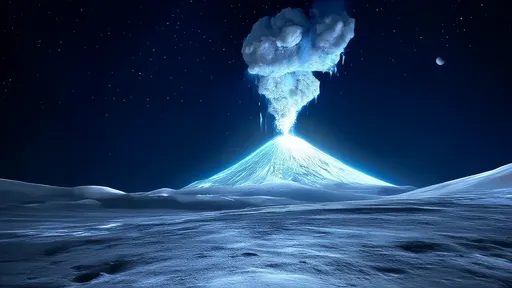
The implications of such findings are profound. If magma circulation follows predictable patterns, it could mean that these hellish worlds possess a form of stability beneath their fiery exteriors. Some researchers speculate that certain tidally locked lava planets might even sustain thin atmospheres, despite the intense stellar radiation, thanks to the constant outgassing from their churning magma seas. Others propose that the movement of molten rock could generate magnetic fields, offering a shield against cosmic rays—a feature once thought impossible for such extreme worlds.
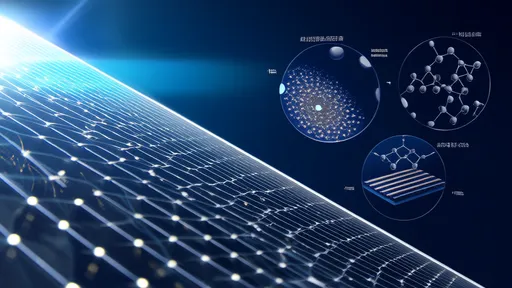
Observational evidence remains scarce, but next-generation telescopes like the James Webb Space Telescope (JWST) and the upcoming Extremely Large Telescope (ELT) may soon provide the data needed to test these theories. By analyzing the thermal emissions and atmospheric compositions of lava worlds, astronomers hope to detect the signatures of magma circulation. Subtle variations in brightness as the planet orbits its star could reveal the ebb and flow of molten rock across its surface.
Beyond the scientific intrigue, these discoveries challenge our preconceptions of habitability. While no life as we know it could survive in a sea of liquid rock, the mechanisms driving magma circulation may parallel those in Earth's own mantle, offering insights into planetary evolution. The study of exoplanetary lava oceans bridges the gap between astrophysics and geology, reminding us that the universe is far stranger—and more wondrous—than we once imagined.

By /Jul 28, 2025

By /Aug 5, 2025

By /Jul 28, 2025

By /Jul 28, 2025

By /Aug 5, 2025

By /Jul 28, 2025
By /Aug 5, 2025

By /Aug 5, 2025

By /Jul 28, 2025
By /Jul 28, 2025

By /Aug 5, 2025

By /Aug 5, 2025

By /Jul 28, 2025
By /Aug 5, 2025
By /Aug 5, 2025

By /Jul 28, 2025
By /Aug 5, 2025

By /Aug 5, 2025

By /Jul 28, 2025

By /Jul 28, 2025
