The vast emptiness between stars isn't quite as empty as we once believed. Interstellar dust streams – those microscopic particles drifting through the cosmic void – have become an unexpected navigational resource for next-generation spacecraft. Solar sail navigation, once considered viable only for inner solar system travel, is now being reimagined for interstellar voyages through pioneering dust stream correction algorithms.
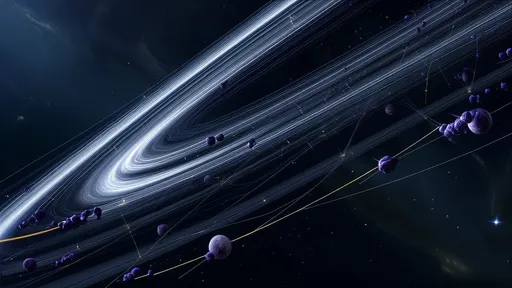
At the heart of this breakthrough lies an elegant paradox: the very particles that pose erosion risks to spacecraft may become their celestial guideposts. Researchers at the Interstellar Dynamics Laboratory have spent seven years mapping the subtle patterns of dust density variations across nearby interstellar space. Their findings reveal that these microscopic particles don't distribute randomly, but flow in complex, predictable streams shaped by gravitational interactions with passing stars and the galaxy's spiral arms.
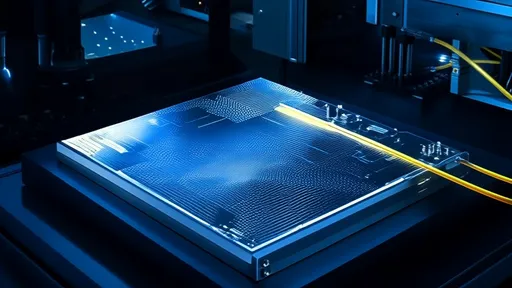
The navigation system works by continuously analyzing dust particle impacts across the sail's surface. Unlike traditional star trackers that require clear lines of sight to distant celestial objects, this method thrives in dust clouds that would blind conventional systems. Each microscopic impact creates vibrations that sophisticated piezoelectric sensors convert into real-time data about the dust stream's direction and density.
What makes this approach revolutionary isn't just its unconventional sensor array, but its self-correcting machine learning architecture. Early prototypes struggled with distinguishing between random dust collisions and true stream patterns. The current system employs quantum-inspired neural networks that can identify underlying flow structures even when 60% of detections represent noise. This tolerance for ambiguity proves crucial when navigating through turbulent boundary regions between different dust streams.
Flight tests within our solar system have yielded astonishing results. The Jupiter Dust Belt Navigation Experiment of 2022 demonstrated course corrections accurate to within 3 arcseconds using nothing but dust density variations. This precision, achieved without any reference to traditional navigational beacons, suggests the system could maintain interstellar trajectories for decades between stellar observations.
Perhaps most remarkably, the algorithm doesn't fight against dust stream variations but harnesses them. When encountering an unexpected flow direction, the system calculates whether to adjust its solar sail angle to compensate or ride the new stream temporarily until a more favorable pattern emerges. This fluid approach mimics ancient Polynesian wayfinding techniques adapted for the space age.
Engineering challenges remain before interstellar deployment. Current sensor arrays require excessive power for continuous operation, and the system's effectiveness in extremely sparse dust regions remains unproven. However, with the Breakthrough Starshot initiative considering incorporation of this technology for its Alpha Centauri mission, interstellar dust may soon transform from navigational hazard to indispensable guide.
The implications extend beyond mere navigation. By analyzing dust stream patterns across light-years, spacecraft could gather unprecedented data about the structure of our galactic neighborhood. Each voyage would contribute to a growing map of the Milky Way's microscopic currents, potentially revealing hidden gravitational influences from dark matter or undiscovered planetary systems.
As we stand on the brink of true interstellar travel, it's poetic that the faintest, most overlooked particles in space may light our way to the stars. The universe, it seems, provides its own roadmaps – we're only beginning to learn how to read them.

By /Jul 28, 2025
By /Aug 5, 2025
By /Jul 28, 2025
By /Jul 28, 2025
By /Aug 5, 2025
By /Jul 28, 2025
By /Aug 5, 2025
By /Aug 5, 2025
By /Jul 28, 2025
By /Jul 28, 2025
By /Aug 5, 2025
By /Aug 5, 2025
By /Jul 28, 2025
By /Aug 5, 2025
By /Aug 5, 2025
By /Jul 28, 2025
By /Aug 5, 2025
By /Aug 5, 2025
By /Jul 28, 2025
By /Jul 28, 2025
