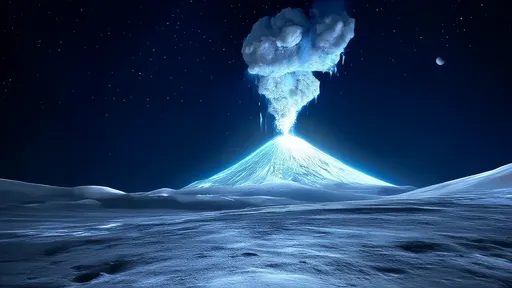
The discovery of icy volcanic activity on the Moon has reshaped our understanding of Earth's closest celestial neighbor. Recent spectroscopic analyses have uncovered compelling evidence of volatile eruptions, leaving behind distinct spectral fingerprints that challenge long-held assumptions about lunar geology. These findings not only reveal a more dynamic Moon than previously imagined but also open new avenues for understanding the distribution and preservation of water and other volatiles in the solar system.
For decades, the Moon was considered a geologically dead world, its volcanic fires extinguished billions of years ago. However, advanced orbital spectrometers have detected unusual mineral signatures near suspected volcanic vents in the lunar polar regions. The spectral data shows telltale absorption features consistent with hydroxyl compounds and molecular water, along with traces of sulfur dioxide and carbon-bearing molecules. These detections point to relatively recent eruptions where volatiles were transported from the lunar interior to the surface.
The spectral fingerprints of these eruptions are particularly fascinating because they differ markedly from those seen in traditional lunar basalts. While most lunar volcanic deposits show iron-rich silicate signatures, these newly identified features indicate explosive eruptions driven by volatile compounds. The presence of water ice mixed with volcanic glass beads suggests a violent eruption process where subsurface water vaporized upon exposure to the vacuum of space, carrying mineral fragments to the surface.
Scientists have identified several candidate ice volcanoes through a combination of topographic analysis and spectroscopic mapping. These features often appear as low, dome-shaped structures with fractured summits, surrounded by anomalously bright ejecta blankets. The surrounding regolith shows spectral characteristics indicative of rapid quenching, where hot volcanic materials rapidly cooled in the presence of volatiles. This creates a unique spectral signature that persists even after prolonged exposure to space weathering.
What makes these findings particularly significant is their potential connection to lunar water resources. The volatiles released during these eruptions may represent a previously unrecognized source of lunar water, possibly trapped in the Moon's interior since its formation or delivered later by cometary impacts. The spectral data suggests that some of these erupted volatiles may have migrated to permanently shadowed polar craters, where they could persist as ice deposits accessible to future exploration missions.
The detection methods rely heavily on sophisticated spectroscopic techniques that can distinguish between different molecular vibrations. Water ice, hydroxyl groups, and various volatile compounds each produce characteristic absorption features at specific infrared wavelengths. By mapping these spectral signatures across the lunar surface, researchers can identify areas where volcanic outgassing may have deposited volatile-rich materials. The spatial distribution of these signatures often reveals patterns consistent with explosive volcanism rather than impact-related deposition.
Dating these volcanic events remains challenging, but crater counting techniques suggest some ice volcanic features may be surprisingly young - perhaps less than 100 million years old. This raises intriguing questions about the Moon's thermal evolution and whether residual volcanic activity might still occur today. Some researchers speculate that deep lunar fractures could still occasionally release volatiles, potentially explaining certain transient lunar phenomena observed by astronomers over the centuries.
The implications for future lunar exploration are profound. These ice volcanic deposits could represent valuable resources for sustaining human presence on the Moon, providing both water and potential feedstock for manufacturing processes. Moreover, the erupted materials offer a unique window into the Moon's interior composition without requiring complex drilling operations. Mission planners are already considering how to target these areas for both robotic and crewed investigations in the coming decade.
As analytical techniques continue to improve, scientists anticipate discovering more evidence of lunar ice volcanism across different geological epochs. Each new spectral dataset reveals subtle variations in volatile signatures that help piece together the complex history of lunar outgassing. These findings are transforming our understanding of how volatiles behave in airless bodies and may have important implications for interpreting similar processes on Mercury, asteroids, and other moons throughout the solar system.
The study of lunar ice volcanoes represents a perfect marriage of planetary geology and spectroscopic remote sensing. As we continue to decode the spectral fingerprints left by these volatile eruptions, we're not just learning about the Moon's past - we're gaining insights that will shape humanity's future in space. The discoveries made possible by these techniques remind us that even our most familiar celestial neighbor still holds surprises waiting to be uncovered.

By /Jul 28, 2025
By /Aug 5, 2025

By /Jul 28, 2025

By /Jul 28, 2025
By /Aug 5, 2025

By /Jul 28, 2025
By /Aug 5, 2025
By /Aug 5, 2025
By /Jul 28, 2025
By /Jul 28, 2025
By /Aug 5, 2025

By /Aug 5, 2025

By /Jul 28, 2025
By /Aug 5, 2025
By /Aug 5, 2025
By /Jul 28, 2025
By /Aug 5, 2025

By /Aug 5, 2025

By /Jul 28, 2025
By /Jul 28, 2025
